

Regimentals Militaria Museum
GERMAN WWII BATTLESHIP ADMIRAL GRAF SPEE LIFEBUOY
GERMAN WWII BATTLESHIP ADMIRAL GRAF SPEE LIFEBUOY
Couldn't load pickup availability
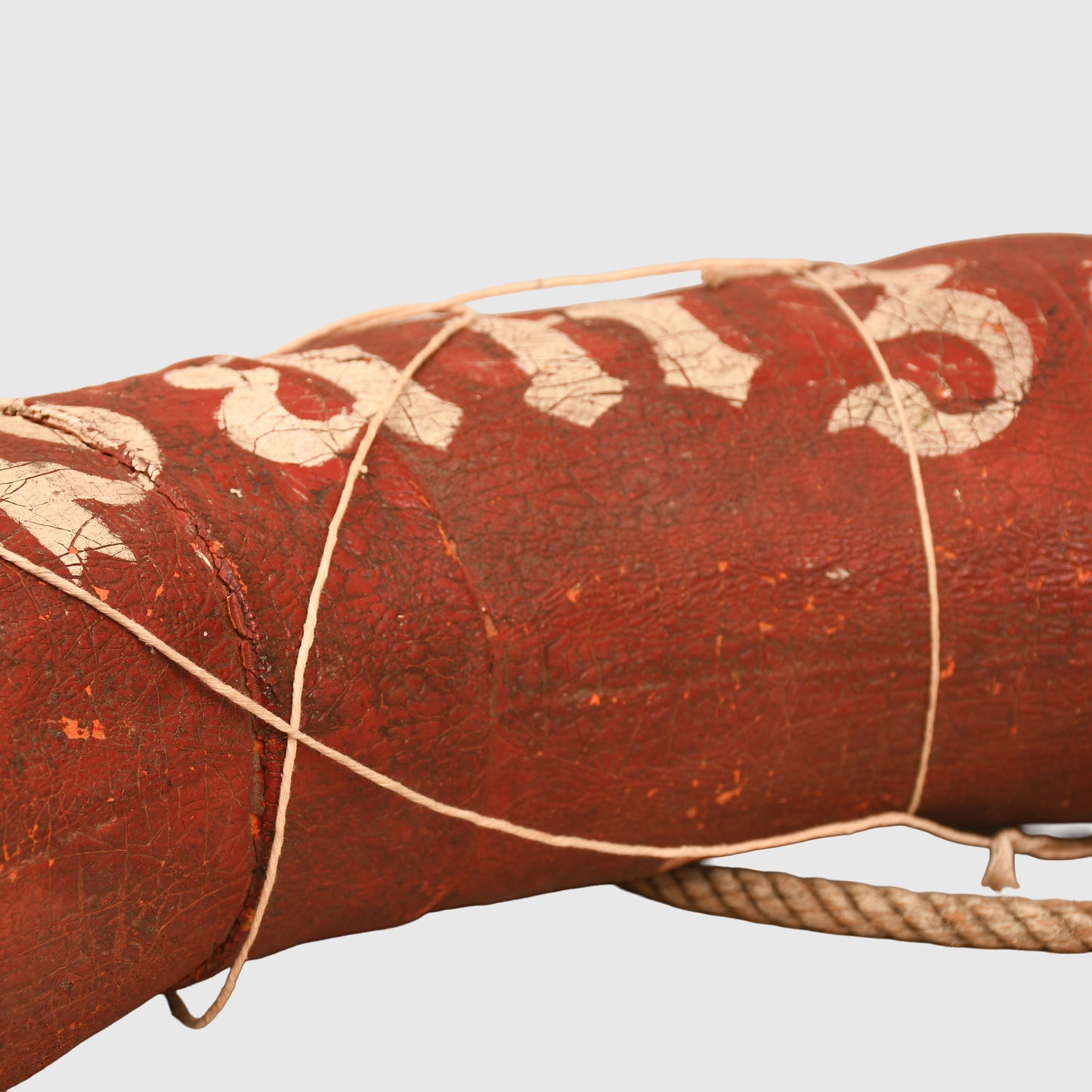
Since the release of the film The Battle of the River Plate in 1956, we have been absolutely fascinated with the story of the sinking of the battleship Graf Spee. In the early months of the Second World War, commonly known as ‘The Phoney War Period’, the German Kriegsmarine wanted to take the battle to the Allies and sent out various sizes of ships, including the pocket battleship the Graf Spee to attack British and Allied merchant shipping. The Graf Spee operated in the South Atlantic and sank a total of 9 merchant ships between September and December 1939. Captain Hans Langdorff was a pre-war gentleman sailor and allowed the crews of the merchant ships to escape from their own ships before being sunk by gunfire from the Graf Spee, the crews were taken aboard the Graf Spee itself. The Royal Navy in retaliation, assembled 9 separate forces to search for the surface raider. On the morning of the 13th December 1939, HMS Exeter, Ajax and Her Majesty’s New Zealand ship HMNZS Achilles spotted the Graf Spee off the coast of South America. All three ships had smaller firepower than the guns of the Graf Spee, but through skilful seamanship, the three cruisers surrounded the Graf Spee and thus split the full volume of the Graf Spee’s firepower. In the ensuing action, HMS Exeter was badly damaged, HMS Ajax and HMNZS Achilles were also damaged, but during the action, the British cruisers had inflicted damage on the fuel supply mechanism of the Graf Spee, and she was unable to manoeuvre successfully. Captain Langsdorff directed the ship towards the neutral harbour of Montevideo in Uruguay. Being a neutral country, Uruguay insisted that, after a period of 72 hours, the ship had to leave the port of Montevideo. Captain Langsdorff was under the impression that there was a much larger force of Royal Navy ships at sea waiting for him and gave orders to scuttle the ship. Langsdorff committed suicide on the 19th December, and his grave can today be viewed in Buenos Aires. The crew, who had been taken off before the scuttling, moved to Argentina, also a neutral country and were interned for the remainder of the war. Quite a few of the crew managed to escape their internment, as it was a very liberal regime of internment, and made their way back to Germany via Japan. The Graf Spee lies in shallow water at the mouth of the River Plate and can be seen from the air depending on the tidal conditions. The large bronze eagle on the bow of the ship has been removed by the government of Uruguay and now lies in a warehouse in Montevideo. The telemeter is on show in the naval dockyard in Montevideo. Over the years, being fascinated with this story, we have been able to obtain many documentary artefacts, including internment passes, crew lists and other interesting documents relating to the internment of the crew. We were also fortunate to have two white summer uniforms assigned to crew members. We have never been able to obtain an artefact as important as this lifebuoy. The lifebuoy is painted red with gothic lettering ‘PANZERSCHIFF ADMIRAL GRAF SPEE’ is in a delicate condition; some of the stitching of the material that covers the horsehair interior has broken and is held together by string. The original rope running to the exterior of the lifebuoy is still intact in its full circumference. Much crazing to the paint, but quite clearly the ‘Graf Spee’. When and how this was removed from the ship is unknown to us, but it has lain in a collection in the United States for many, many years. We cannot think of an artefact of the Kriegsmarine from WWII that we have had over the years as important as this. This was Great Britain’s first victory of the war and was celebrated accordingly. A sub story to the sinking of the Graf Spee, also fascinating is that the British merchant ship crew prisoners taken aboard the Graf Spee were transferred to the depot ship The Altmark, The Altmark then sailed back to a Norwegian Fjord, British Intelligence found The Altmark and launched a raid in mid February 1940 by HMS Cossack who pulled up alongside The Altmark in the dead of night and boarded The Altmark, with boarding cutlasses and small arms liberated all the prisoners, 8 German sailors were killed and 10 wounded during the fighting with the boarding party.
Ref; 96529